China becomes major global supplier of green fuel, with production capacity of 8m TOE in 2025_我的网站
A |
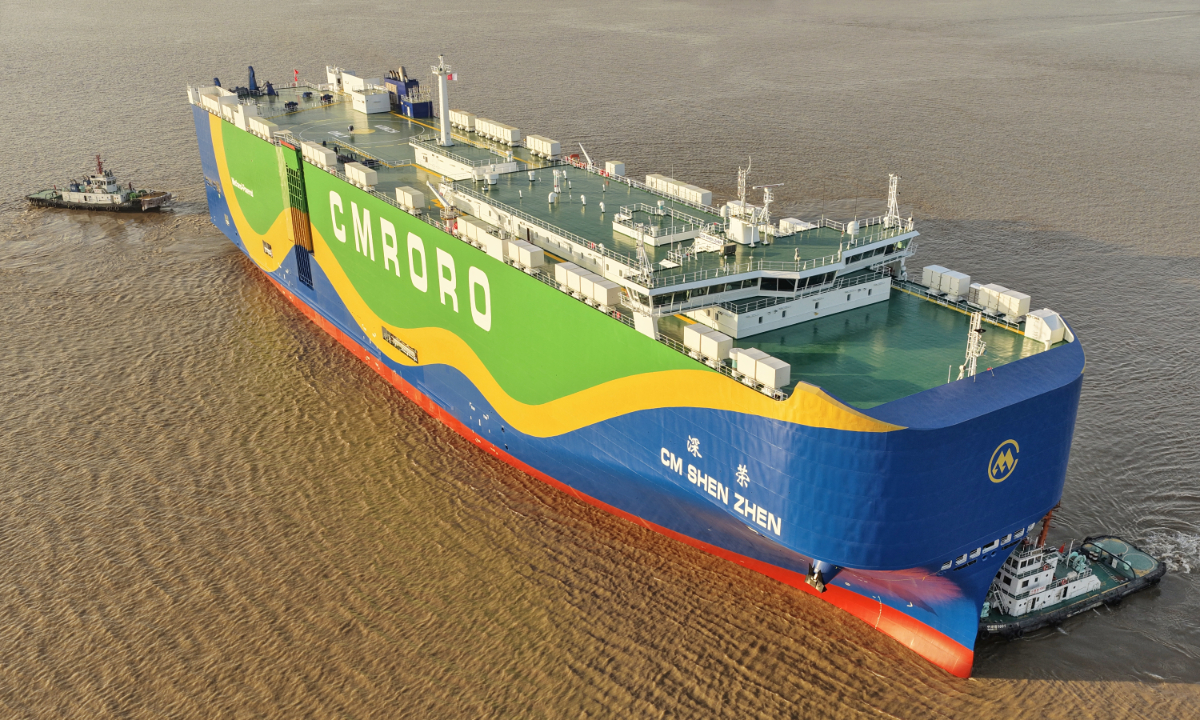
China's first independently developed ultra-large methanol dual-fuel roll-on/roll-off (ro-ro) ship begins its maiden voyage in Nantong, East China's Jiangsu Province, on December 8, 2025. With a capacity equivalent to 9,300 cars and 78,400 square meters of deck space, the ship will carry new-energy vehicles to Europe. Photo: VCGChina's green fuel industry has made phased progress, with production capacity steadily increasing. As of the end of 2025, the country had green fuel production capacity of about 8 million tons of oil equivalent (TOE) per year, according to a report released by China's National Energy Administration (NEA) on Wednesday. The output of green methanol reached 380,000 tons, green ammonia stood at 700,000 tons, and sustainable aviation fuel hit 1.7 million tons, making China a major global supplier, the report showed. The NEA published the China Green Fuel Development Report (2026) on its website on Wednesday. Downstream application scenarios for green fuels in China continue to expand, with coverage extending from land transportation to the shipping, aviation and industrial sectors, the report showed. China's green methanol production capacity accounted for 60.3 percent of the world's total in 2025, according to the report. The ratio for green ammonia was 79.5 percent. Green fuels, represented by green methanol, green ammonia, and sustainable aviation fuel, are fuels with low carbon emissions throughout their entire life cycles and in compliance with environmental protection requirements. In recent years, global climate governance constraints have tightened, and the global energy mix has accelerated its transition toward clean and low-carbon sources. International organizations such as the International Maritime Organization and the International Civil Aviation Organization, as well as countries and regions including the US, the EU, and Brazil, have introduced policies to promote carbon reduction in key transportation sectors. Analysts said that China's development of green fuels not only supports deep decarbonization in key industries and addresses the bottleneck of large-scale renewable energy absorption, but also helps cultivate new drivers of economic growth. That's very significant in supporting global climate action and promoting a comprehensive green transformation of the Chinese economy and society, they said. Although China has taken a leading position globally in green fuel production and equipment R&D, key technological equipment still requires further breakthroughs, Li Zhijian, vice president of the China National Petroleum & Chemical Planning Institute, said in a post on the NEA's website. In particular, there remains considerable room for improvement in areas such as biomass gasification efficiency and the performance of high-efficiency synthesis catalysts - areas that urgently need focused research efforts, Li noted. According to projections from domestic and international institutions, global green fuel demand is expected to reach about 10 million TOE by 2030 and exceed 100 million TOE by 2050, indicating vast room for industrial growth. China, rich in renewable resources such as wind, solar, and biomass, provides a solid foundation for large-scale development of the green fuel industry, the NEA said. China could achieve green electricity from a total installed capacity of 3.6 billion kilowatts for wind and solar power, with an annual available volume of organic waste of some 617 million tons by 2035. If reasonably used for green fuel production, this could support an industrial scale of about 10 million TOE, Li said, citing an industry estimate. Global Times 。
B | 之前乌克兰人曾多次从哈尔科夫越境进入俄罗斯,还发起对俄偷袭行动,所以这次俄罗斯准备打出一个“隔离地带”来保护自己的安全。但有乌克兰消息人士对此并不信任,认为俄罗斯到底打到哪里是根据“实际情况”决定的;如果乌克兰人抵抗不及时,俄罗斯或许会吞并整个哈尔科夫地区。
同日,乌克兰总统泽连斯基接受媒体采访,对他们现在遭遇的困境表示不满。
C | 记者询问是否认为哈尔科夫州的失利是“美国人的问题”,他则回答:“这是全世界的错误,全世界给了普京占领我们的土地的机会,各国现在应该帮助乌克兰”。采访者认为泽连斯基非常不满于之前各国没有给他们足够的援助,因为3月份他同样将阿夫杰耶夫卡的战败归咎于“各国没有给支持”,现在来看哈尔科夫同样如此,都是因为少了援助才导致的结果。



 威少退役登全美第一热搜!两队给合同遭拒 名嘴:该退役球衣+塑雕像
 PM to dedicate 75 Digital Banking Units today
 多元业态升级!“电影+”延伸光影消费链条,多元业态升级!“电影+”延伸光影消费链条
 数千人聚集怀唐伊 在条约签署地参加黎明仪式
 微软专利揭示能调节表面粗糙度的先进显示屏
 兴城市大力支持校服及工装产业发展